

A Community's Promise: LaMCoT at the 11th Our Ocean Conference
When the 11th Our Ocean Conference (OOC11) opened its doors in Mombasa on 16th June 2026, it made history. For the first time in the conference's 11 editions, the world's premier ocean conservation gathering was held on African soil, and under a theme that felt made for this moment: Our Ocean, Our Heritage, Our Future.

Over 5,000 delegates from governments, scientific institutions, civil society organisations, and coastal communities gathered at OOC11. Resultantly, 104 countries and organisations made 320 voluntary commitments totalling USD 6.4 billion toward ocean conservation, sustainable fisheries, and maritime security. The Mombasa Declaration on fisheries transparency was signed by 16 nations. Kenya joined a global coalition to protect climate-resilient coral reefs. African nations, which for the longest time have been recipients of decisions made elsewhere, stepped firmly into a leadership role.
LaMCoT was there. Rooted in Lamu, represented with pride.

Bringing Lamu's Voices to a Global Stage
Our presence at OOC11 centred on the Ocean Matriarchs Photostory Exhibition, a dedicated exhibition space showcasing the lives, leadership, and ocean relationships of women from coastal fishing communities. The exhibition, in partnership with Blue Ventures, featured women from Kenya, Madagascar, and Senegal - among them Diaba Diop, President of REFEPAS, the Network of Women in Artisanal Fisheries in Senegal. These women are from fishing communities where locally led marine conservation is not a theory but a daily practice.

At the heart of the Kenyan story was Amina Komora; a traditional fisherwoman, community midwife, and voice of the Sanye community. Amina attended the conference in person, engaging visitors directly at the exhibition. When she first stood before the exhibition and saw her face, her granddaughter's face and her community's story displayed for the world to see, she was moved to tears.
"A woman from Sanye, a highly marginalised community, is now accessing a global platform, and our story is being seen by the world." ~ Amina Komora
It was a moment that reminded us why this work matters beyond data and policy.
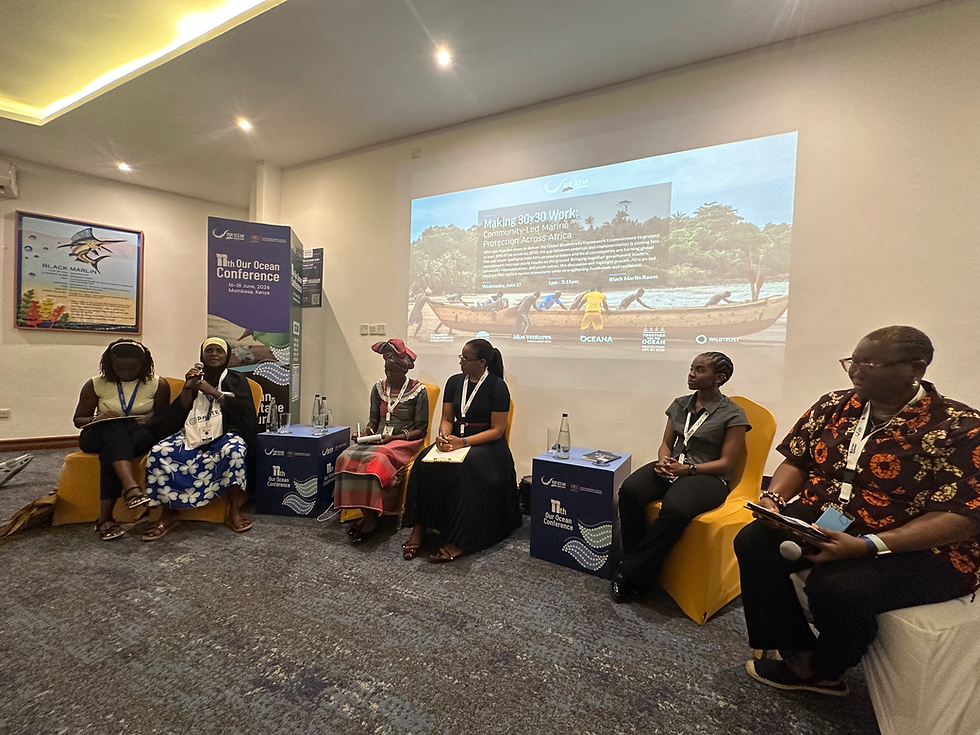
Amina's voice carried just as powerfully on the conference floor. At the side event ‘Making 30x30 Work: Community-Led Marine Protection Across Africa’, she spoke with clarity and conviction on behalf of her community. She stated that for the global 30×30 ocean protection target to succeed, local communities, including the most marginalised, must not only be consulted, but genuinely included. She called for unity across all levels of governance.
Amina asked a question that lingered in the room long after the session: "How can we speak of communities conserving the ocean when they are foot fishers who cannot even access the open sea?" She called for tangible support: fishing gear, boats, and livelihood, because, as she put it plainly, nobody can conserve while hungry.
Amina also joined a panel alongside Kate Walsh (Ambassador for Oceana), Zulfa Hasaan (Mama Mikoko) from Mtangawanda, and Raabia Hawa from the Lamu Environment Foundation. Three women from Lamu, speaking to the world about what it means to lead conservation from within your community, not from a distance.
Our Booths, Our Commitment
Beyond the exhibition, we showcased our conservation programmes at the booths, alongside WildAid and the County Government of Lamu. We brought our annual Bahari Yetu Festival to new audiences, a UN Ocean Decade-recognised event that returns this October with the theme "Voices of the Ocean."

Visitors to our booth were invited to write their personal ocean commitment on a fish-shaped card - a simple, tangible act of solidarity that connected the global agenda to individual conscience.
And we made a formal commitment of our own.
LaMCoT commits to operationalising the Kinyika Fisheries Management Zone within the wider Lamu Bay Joint Co-Management Area - a community-led contribution to sustainable fisheries, marine protection, and Kenya's 30×30 ocean ambition. The wider JCMA covers approximately 920.8 km² of coastal and marine waters, developed through a participatory process with 10 Beach Management Units: Amu, Kiongwe Mjini, Kipungani, Mashundwani, Matondoni, Mea, Mkunumbi, Bandari Salama, Ndambwe, and Shela.

Kinyika itself is an ecologically vital reef and fishing area near Lamu and Manda islands, home to coral reefs, reef fish nurseries, dolphins, humphead parrotfish, Napoleon wrasse, reef sharks, and whale sharks. It is also under pressure. This commitment is our answer.
Grounded in the voice, leadership, and priorities of the fishing communities who depend on Lamu Bay for food, income, culture, and identity, our commitment will strengthen BMU-led monitoring, fisheries data systems, compliance, and financial inclusion through:
Village Savings and Loan Associations,
GPS/GIS mapping
Patrol reporting,
Fish catch documentation
This is how we turn community knowledge into community power.
A Conference That Named Us
One of the quiet highlights of OOC11 for our team was reading the language of the conference. Global partners noted that community-led initiatives, such as locally managed marine areas in northern Lamu, are demonstrating how effective protection can support biodiversity, fisheries, and coastal livelihoods. The WIO LMMA Alliance - a new regional platform to amplify community voices and connect local conservation action to global ocean agendas- was formally launched at the conference. This is the ecosystem in which LaMCoT works every day.
The Mombasa Declaration's call for fisheries transparency, data accountability, and combating illegal, unreported, and unregulated fishing aligns directly with the fisher and trader logbooks, BMU data systems, and compliance monitoring at the heart of our Kinyika commitment.
What Comes Next
OOC11 has set a direction. But as voices from grassroots organisations, policymakers, international researchers, and small-scale fishers at the conference reminded us, the measure of this moment will be in what happens after the delegates go home.

LaMCoT returns to Lamu with renewed energy, new relationships to build on, and a formal commitment to the world that the Kinyika Community Management Area will become a living example of what community-led ocean governance can achieve.
We hope to see you as you join other Voices of the Ocean at the Bahari Yetu Festival 2026, where this conversation continues.
~ Written by Evelyn Kimori


Comments