

3 Schools, 2 Islands: Our Outstanding Clubs Go Exploring
Ask a child what they remember about school, and they will rarely tell you about a lesson. They will tell you about the day they left the classroom.

This year, sixty students from 3 of our 14 Environmental Kindness Clubs earned exactly that kind of day. They were awarded environmental excursions for shining at the Bahari Yetu Festival 2025; a day we celebrated nature under the theme Hifadhi Bahari, Hifadhi Maisha (Protect our Ocean, Protect Lives).
The young conservationists got to witness, in the most literal way, how nature produces medicine, soap, cement and color. Read on!
Art Competition Winners at Natural Lamu

Siyu Primary School, under the leadership of their patrons, Mr Said and Madam Yumna Abudi, took the top prize in the festival’s Recycled Art Competition. Their reward was a day at Natural Lamu, the farm-to-skin workshop where lip balms, soaps and perfumes are made entirely from what grows on this archipelago.
Met with friendly staff (mostly women), we toured the farm where the students got to see the raw material of Natural Lamu’s products and how they were cared for to grow organically. They also went into the factory and labs, and under keen supervision, they practically took part in making soap, beauty products, and wooden carvings.
Highlights from the trip to Natural Lamu

The making of Pendo Lip Balm: the students measured and mixed the ingredients for Natural Lamu's Pendo 4-in-1 makeup balm themselves. They were particularly fascinated by a key star ingredient: non-nano zinc oxide, which provides a natural, coral-reef-friendly shield against the sun. At the end of the day, they each got a balm for keeps!

Soap-making: the attention to detail and safety precautions when handling ingredients and chemicals was impeccable! After making the soap, the creative hands got to decorate the soap molds before they were set aside to solidify.
Secrets of coral powder: who knew that ants in your compost (especially cow dung) are a clear indicator of it being too acidic? Since coral powder is basically calcium carbonate, which is alkaline in nature, it is mixed with acidic compost to neutralize the pH. Talk of finding natural solutions to natural problems!
The same coral powder is what Natural Lamu packs into the carvings on their fridge magnets and keyholders sold to visitors to give the crisp white inlay that everyone mistakes for paint - but that's a secret!

The day ended with lunch and a long swim, both hosted by Natural Lamu. Our sincere thanks to the team there for opening their farm, their workshop and their day to us.
Conservation Champions at The Takwa Ruins
Of the 14 school clubs (containing 20 students each) under our Pan-African Conservation Education (PACE) program funded by Tusk Trust, we picked the best-performing two based on leadership, community outreach, sustainability projects, networking, record-keeping and regional recognition.
Under the leadership of their patrons, Mr Japhet and Madam Yumna Amini, Manda Maweni Primary School returned as our School Champions, winning a football and an excursion. Wiyoni Primary School, led by their patrons, Mr James and Madam Kamari, came second. On two separate trips, both clubs crossed to Manda Island to walk through the ruins of Takwa.
A town that ran out of water
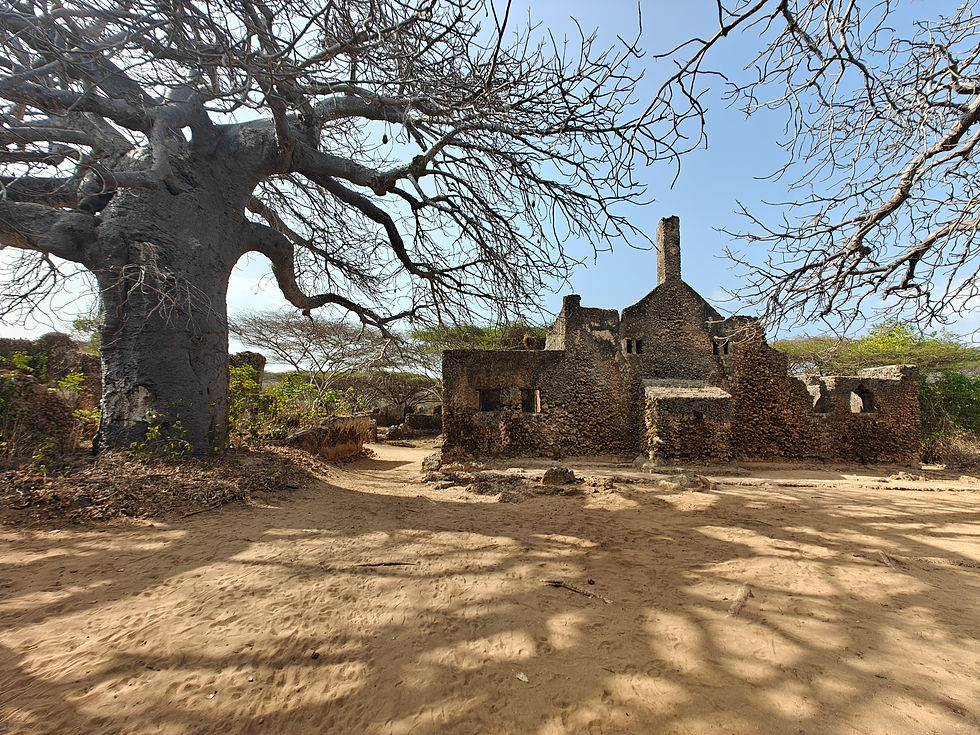
Takwa was home to around 2,500 people living in some 150 houses in the 16th century. By the 17th century, they resettled at the sand-dune-rich Shela on Lamu Island, across the water. A whole town, with its mosque and its walls and its wells, undone by the one thing it could not manufacture - fresh water!
Standing in that emptiness, our students, who spend their club meetings learning about water, waste and the ocean, were looking at what happens when a community outlives its resources. Nobody needed to spell out the lesson.
Highlights from the Takwa Ruins Excursion
Ancient construction material and styles: how did they build without cement? Limestone was stacked with mangrove wood into a kiln and burned down to chokaa (powdered lime), which, mixed with water, set hard enough to raise a town whose walls, mosque and gravestones still stand five hundred years later.
Ordinary homes had indoor toilets - a detail the guide made sure landed properly: this was not something borrowed from the West. It was built here, centuries before anyone arrived to claim they had invented it. If anything, the borrowing went the other way.

And the girls' room, at the heart of the house, was where a family's private life happened - where babies were born, where the dead were washed, where secrets were kept.
Ancient technology: the clay pots that keep water cool without electricity. The kiko. The siwa ya kupiga mbiu, the horn sounded to summon a town that had no loudspeakers.
Generational baobab trees that foretold the weather: we saw the grandparent baobabs (roughly 500 years old) and mama and papa baobabs (roughly 300 and 400 years old), old enough to have watched the town empty. Female baobabs bear more fruit than males, and larger mabuyu. Small leaves appearing on the branches mean the rains are coming.
A rich source of vitamin C, the baobab fruit powder is used as a spice, and the bark and pulp have long served as soap for hair, especially when worked together with soil.

Both trips ended the same happy way: a swim in the ocean and a picnic at Somo's, on Manda Beach beside the Majlis Hotel.

Students from Wiyoni Primary School sent us off with three poems of their own — urging all of us to love the ocean, keep the environment clean, and thanking LaMCoT for what they have been taught. We are not sure who was more moved, the students or us.
Oh, Turtle of Lamu, swim on free.
A symbol of our shared legacy.
May everywhere, your story tell.
That love for nature, sail as well.
‘Answer the ocean’s ancient call’, the sea whispers, ‘keep me clean’
~ some lines from a poem by
Wiyoni Pri. Sch, 2026.
Are Excursions Worth it?

Reflecting upon the knowledge these children gained, nature has so many solutions to our daily-life problems. Every one of them is here in Lamu - its reefs, its trees, its kilns, its grandmothers, some of it for five hundred years.
That is what excursions are for - not a day off, but a day when the classroom finally gets big enough to hold the island. To Natural Lamu, our guides at Takwa Ruins, and the patrons and teachers who make these clubs work, thank you so much!
We are already working towards Bahari Yetu Festival 2026, on 10th & 11th October, under the theme ‘Voices of the Ocean’ (Sauti za Bahari).
Who will earn next year's excursion? Follow us @lamcot_lamu and find out.
Photography and Blog by Evelyn Kimori


Comments